A schedule from day one
Ten services, each with a distance and a date. With no history at all it projects from the odometer, so there is nothing to fill in before it works.
GearGenius is a car maintenance app for iPhone and Android. One health score, a schedule that knows what is due, and a service history that follows you.

GearGenius turns a vehicle into a dashboard. A single health score out of 100, a maintenance schedule that knows what is due, and a service history that follows the owner rather than the dealership.
Add a vehicle once, and the app works out the rest.
New in 1.1
Genie lives in the app and keeps an eye on your car, so you do not have to. When a service is getting close he says so and offers to find a garage nearby. Ask him anything about your car and he answers in plain English, already knowing its age, its mileage and its history. And he teaches you the checks worth knowing: five short lessons you do on your own car, a few minutes each.
His mood follows your car. Watch the gauge on his chest.




Learn with Genie
Keep a daily streak and earn Gears as you go. Free, like the rest of the basics.
Set up once
Make, model, year, fuel and the odometer. That is the whole setup. The VIN can be scanned with the camera if you want recalls, and everything below happens whether you open the app again or not.
Ten services, each with a distance and a date. With no history at all it projects from the odometer, so there is nothing to fill in before it works.
Genie sends one a week before each service falls due, and another the day before. The reminder is the operating system's own, so it arrives whether or not the app is running.
Sunday morning, it asks for the odometer. Every derived figure on the dashboard decays until somebody answers it. The score, the next service, the yearly usage.
Looked up against the manufacturer safety databases by make, model and year. Add the VIN and it narrows to your car rather than your model.
Log a service and it stays with the vehicle on your account. Not with the garage that did it, and not with the dealership you bought it from.
Service upkeep is worth 50 of the 100 points, and it is the only part that can go up. Log what you have had done and it rises; fall behind and it falls. Twenty more points move with how far the car is driven against what is normal for its age. The last thirty are settled the day you buy it: the age, the brand's record, the powertrain.
Which means an older car kept properly outscores a newer one nobody has touched. Change anything below and watch where the points go.
A 2021 Honda with 43,200 miles on it.
Each of these builds a real list of services at real odometer readings and dates, then scores it. Nothing is tabulated.
Every service carries two deadlines, a distance and a date. Whichever runs out first is the one that makes it due. Brake fluid has no mileage at all: it absorbs water out of the air whether the car is driven or parked, so it comes round every two years regardless.
With no history at all, the next one is projected from the odometer alone. Log a service and the projection becomes a measurement.
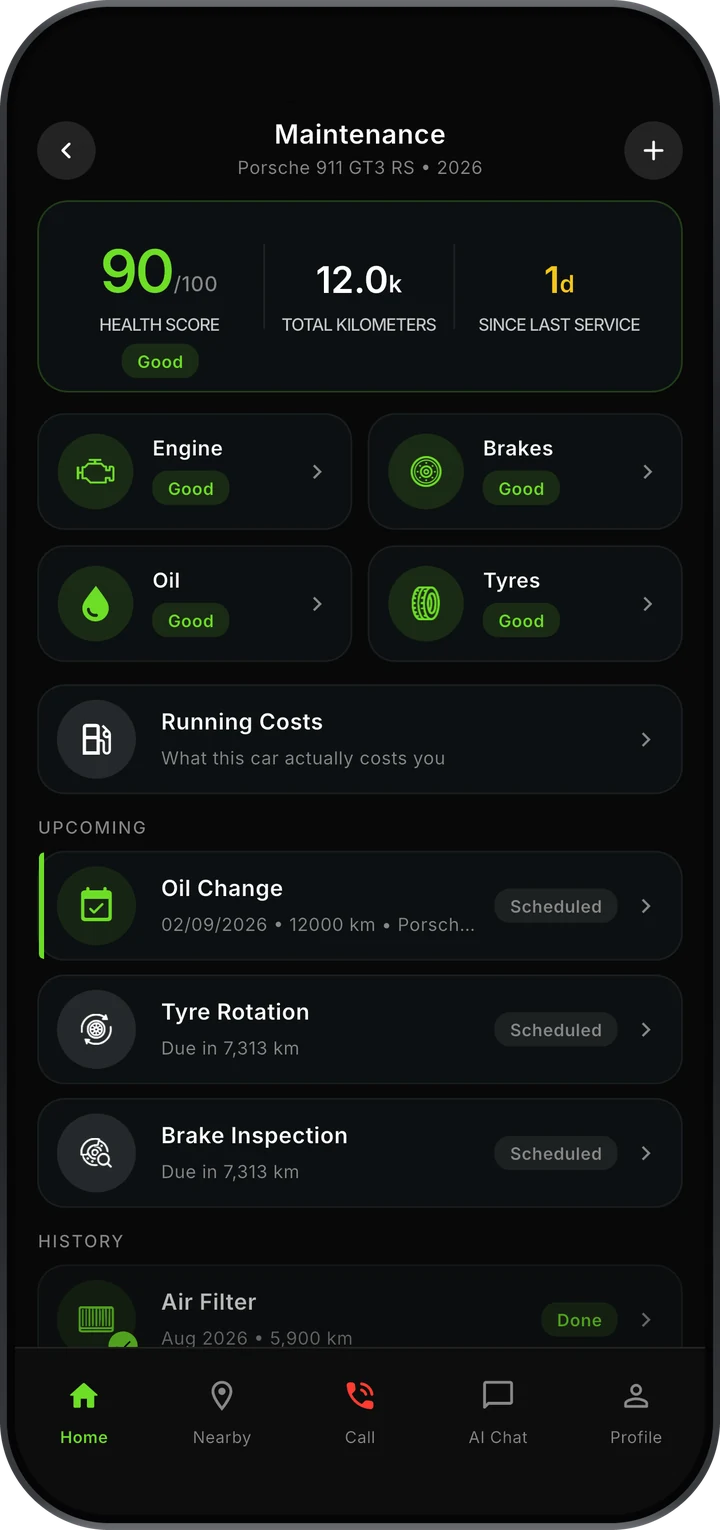
The distances are not round because the app does not hold them in kilometres. They are conventional maintenance-schedule figures in miles, converted on the way to the screen. Which is why its own maintenance list reads “Due in 7,313 km” rather than a tidier number.
Those are a petrol car's. An electric one gets its own list rather than that one with three things crossed out: no oil, no plugs, no gearbox fluid, a battery check every year, and friction pads that last 120,701 km because the motor does most of the slowing.
Know more. Pay less at the shop.
Every one of them is built on what the app already knows about your car. None of them needs a data feed we would have to buy, which is why they can exist at this price at all.
Know your car's true value before the dealer does.
A private-sale range and a trade-in range, with every term that moved them shown as a signed percentage. And what each overdue service is costing you.
A range with its working shown, never an exact figure. No listing or auction feed behind it, and it says so.
Check their quote against your own service history.
Enter the lines off a garage's estimate. It answers from your record: when that was last done, at what mileage, and whether the interval agrees.
It reads your history, not your car. A part can fail early. This is for asking better questions, never for refusing work.
Walk around a used car, and know what to offer.
A guided walkaround in the order it has to happen. Cold start first. Answer what you see, and it totals what the findings are worth off the asking price.
Arithmetic over what you saw yourself. No database behind it, which is exactly why it works in any country.
Sharper answers when it counts.
Ask Genie, on a stronger model. He already knows the car: its age, its mileage, what is overdue, what you have logged. You are not pasting your history into a chatbot.
Up to five vehicles. Cover your whole household.
Every car gets its own score, schedule and history. The free tier keeps one, and keeps it properly.
Plug in, and read what the car itself says.
A fault code is five characters and a manual. Read it off the port under Car Insights, beside your recalls and your valuation: every code the car is holding, the live sensor values behind them, and whether the engine light is genuinely on or the car simply would not say.
Needs a Bluetooth LE adapter you buy once, separately. Nothing on the dashboard depends on owning one, and a scan is shown to you and thrown away rather than stored.
And the free tier is not a demo
All five factors with the full breakdown, and ten services tracked on both a distance and a date.
Log a fill-up and it works out the real cost. Per month, per kilometre, and the economy you actually get.
The shops near you that sell what your car needs. Call two and you have a figure to hold against the quote.
Garages and fuel around you. Apple Maps on iOS, Google Places on Android. Emergency services stay one tap from every screen.
The background is cut away on the phone itself, the location your camera wrote in is stripped, and the photo never leaves the device.
English, German, Greek, Spanish, French, Japanese, Portuguese and Chinese. The service catalogue too, not just the buttons.
No advertising network, no analytics broker, no cookies, and no tracking of any kind. Your car's photo never leaves the phone it was taken on. The full policy is one page and reads like one. Read it here
Feedback
GearGenius is new, which is the best time to change it. If something here would not work for your car, or the one thing you actually want is not on this page, that is worth more to us than a polite note.
Tell us what you drive and what you would want it to do. Every message is read.
Free to download. Genie, the health score and your service schedule are waiting.


iPhone and Android, from one app